I walked past my son’s room and saw him sitting at the edge of his bed. He was eleven. His fists were pressed between his knees and he had folded himself inward, as if trying to disappear without moving.
I knocked on the open door. Asked if he was okay. He shook his head slightly. Then, after a long pause, he said he was fine. But it wasn’t the kind of fine that ends a conversation. It was the kind that leaves the door ajar.
Everything in me wanted to fix it. To say the right thing. To draw him out or offer him something useful. That impulse is well-worn in me. When someone is in pain, I scan the room for exits from it. A reframe. A story. Anything that might soften what’s sitting in the air.
But this time I didn’t. I sat down close enough to be near and asked if I could stay. He nodded. So I did, and I said nothing.
We sat like that for maybe five minutes. No words. No strategy. Just the quiet hum of being near someone. Then something in him shifted. His shoulders came down. His chin lifted slightly. And in a voice barely above a whisper, he said he didn’t feel sad anymore. Then he stood and went to find his brother.
No explanation. No tidy resolution. Just that quiet return to himself.
I’ve thought about that moment a lot. What I was beginning to understand, without quite having the words for it yet, was that the silence hadn’t been empty. It had been doing something. Stephen Porges, the neuroscientist behind polyvagal theory, describes how our nervous systems attune to one another in real time. When someone is truly present with us, not performing presence but actually offering it, it signals safety. Not through words. Through steadiness.
My son didn’t need me to say anything. He needed me to stop filling the space with my own discomfort. The silence wasn’t asking me to speak. I just assumed it was.
That’s the habit I had to unlearn. The reflex to reach for something useful whenever a moment grew still. I told myself it was care, but a lot of the time it was closer to avoidance. Silence made me restless. I filled it not because it needed filling, but because staying inside it felt like doing nothing, and doing nothing felt like failing.
It isn’t nothing. That’s the thing. Staying present without steering, without fixing, without offering your own meaning on top of someone else’s pain, is one of the harder things most of us will ever attempt. And one of the most useful.
One breath longer than you usually would. That’s often all it takes.
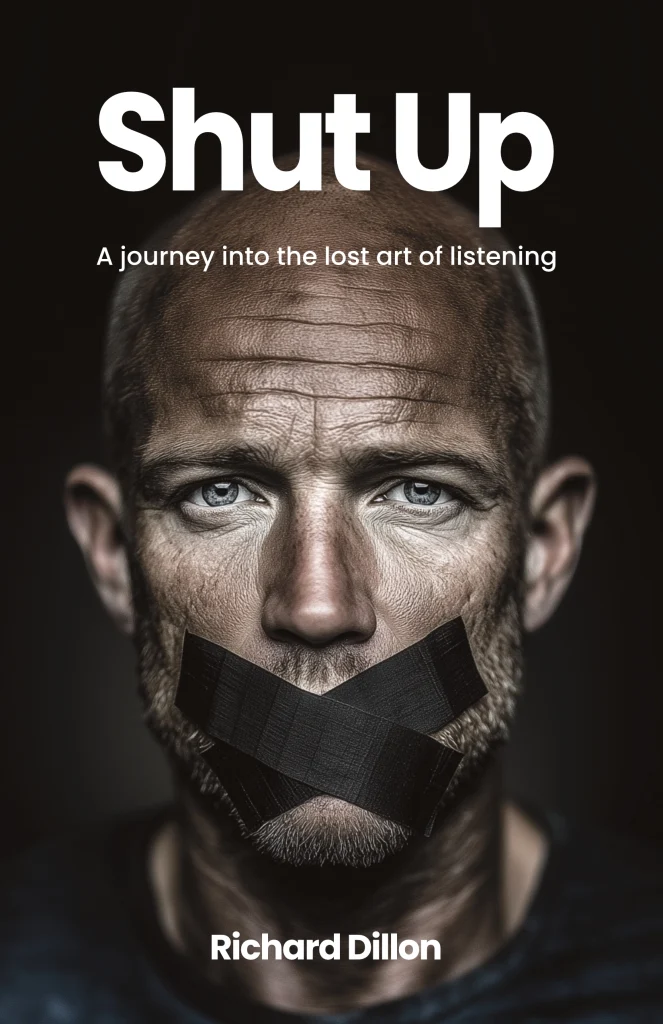
My book “Shut Up: A Journey into the Lost Art of Listening” is available on Amazon if you want to go further with this.