Something small happened at home recently and I’ve been thinking about it ever since. We moved the sofa. Afterwards, my partner noticed a mark on it. Nobody knew whether it was new, or had simply become visible from the new angle.
Two versions of that moment exist. In one, you say: “You marked the sofa.” In the other: “Since we moved the couch, I can see a mark.”
Same observation. Completely different conversation.
The first isn’t really a statement. It’s a verdict. And the moment it lands, the other person does one of two things. They push back, defend, explain. Or they fold inward, apologising from a place of guilt rather than honesty, absorbing it as proof of something they already believed about themselves.
Neither response is what you actually wanted. What you wanted was to figure out what happened and maybe what to do about it.
Here’s what I’ve noticed: the word “you” in those moments isn’t really a pronoun. It’s a finger pointing. When a finger points at someone, their nervous system doesn’t stop to reason through it. It reacts. It protects. Even if the person suspects they caused the mark, even if they want to own it, the blame has already closed the door.
Nonviolent Communication makes a distinction I keep returning to. There’s a difference between an observation and an evaluation. “I can see a mark on the sofa” is an observation. “You marked the sofa” is an evaluation. One states a fact. The other assigns a cause, a culprit, a story about who you’re dealing with.
When Antoinette and I have tried the first way, something real changes. There’s room. The other person isn’t scrambling to escape or collapsing under the weight of an accusation. They’re free to enter. “Oh, that might have been me.” Said simply, without drama, from clarity instead of guilt.
That’s what personal responsibility actually looks like. Not the forced apology that comes after being backed into a corner. The honest one that arrives when nobody needed to defend themselves in the first place.
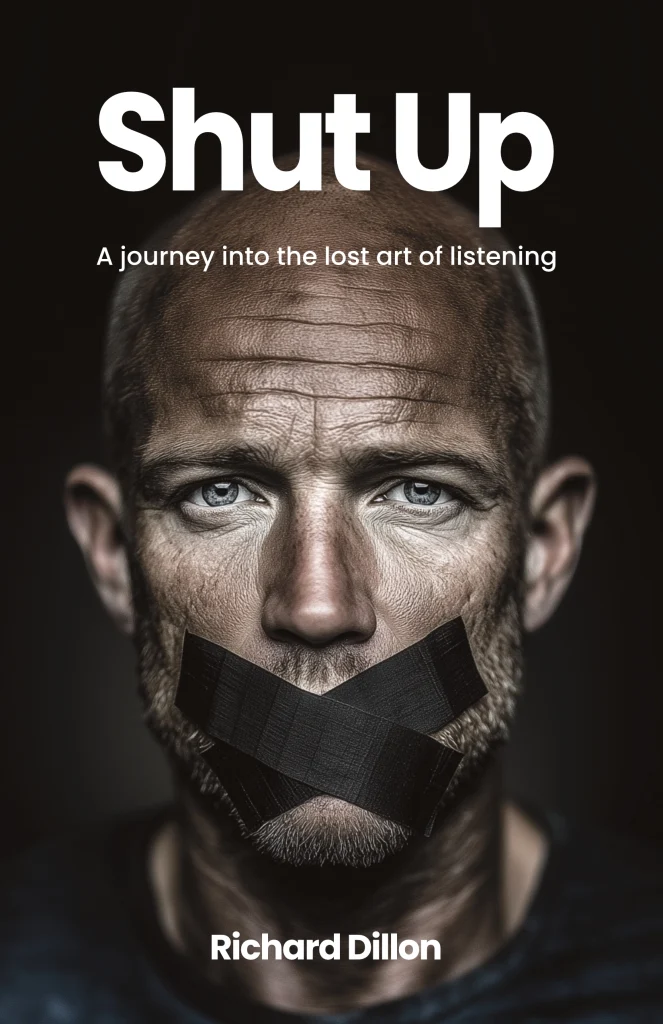
My book “Shut Up: A Journey into the Lost Art of Listening” is available on Amazon if you want to go further with this.
AI has been used for research, spelling, grammar, general sentence structure, and images in the creation of this piece.